
From Idea to First Launch: Documents Behind a Gift Range
For a first fragrance launch, the documents are not paperwork that follows the product; they are the thing that decides whether the product can be sold at all. A festive gifting range raises the stakes again, because the label, the pack and the safety documentation all have to be final before the season's production slot, and a missing input in November cannot be fixed in December. The encouraging part is that the document set is finite and predictable. What follows is the order in which those documents are actually produced, who produces each one, and the point at which leaving one out turns into a launch delay.
Key takeaways
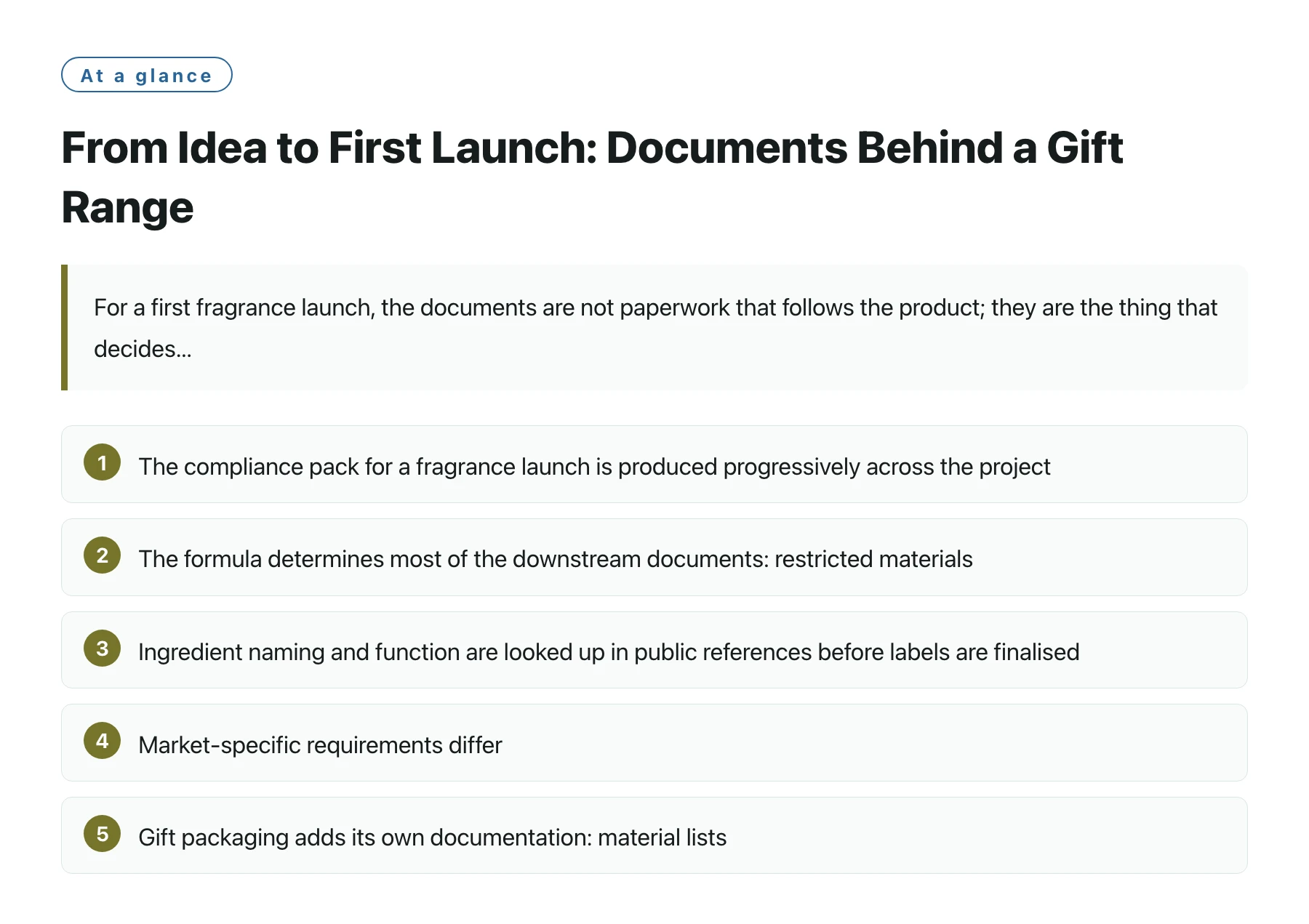
- The compliance pack for a fragrance launch is produced progressively across the project, so the document list should be opened at the brief stage rather than after the scent is approved.
- The formula determines most of the downstream documents: restricted materials, ingredient disclosure, allergen information and safety assessment all trace back to it [1].
- Ingredient naming and function are looked up in public references before labels are finalised, which avoids a last-minute rewrite of artwork [2].
- Market-specific requirements differ, so a range sold in more than one country needs its label and documentation checked per market rather than once globally [3].
- Gift packaging adds its own documentation: material lists, dielines and any packaging compliance statements that apply in the destination markets [4].
- The documents a founder should hold personally are the ones that survive a change of supplier, because they are what make the range reproducible elsewhere.
Founders usually discover the document list in the wrong order. The scent is approved, the bottle is chosen, artwork is commissioned, and only then does someone ask which tests exist, which market requirements apply, and what has to appear on the pack. At that point every answer is expensive, because artwork and tooling are already in motion.
The alternative is to treat the compliance pack as a project deliverable that is assembled alongside the product. Nothing about that requires legal expertise. It requires knowing which documents exist, which party produces each one, and which inputs have to be settled early because other work depends on them.
This is the sequence from idea to first launch, written for someone doing it for the first time and working towards a festive gifting range with a date that does not move.
The document set, in the order it is produced
| Document | Who produces it | What it unlocks |
|---|---|---|
| Agreed brief and scope | Brand and manufacturer together | Development work, and the baseline for every later change |
| Formula specification with version number | Fragrance development team | Restricted-material review, ingredient disclosure, allergen information and safety assessment [1] |
| Ingredient naming and function records | Manufacturer, checked against public references | Label text that will not need rewriting after artwork approval [2] |
| Compatibility and stability reports | Manufacturer or independent laboratory | Confidence that the formula survives the pack, and evidence for a reorder |
| Safety assessment or equivalent | Qualified assessor in the destination market | The market entry itself, since many markets require it before sale |
| Label and artwork files, per market | Brand with manufacturer input | Printing, and clearance of any market-specific requirements [3] |
| Packaging material and dieline records | Packaging supplier, held by the brand | Gift assembly, reorders, and any packaging statements the destination market requires [4] |
| Retained reference standard | Manufacturer, accessible to the brand | Comparison of the next batch against the approved one |
Two things stand out in that list. The first is that most documents are produced by the manufacturer, which means the brand's job is to ask for them by name and to check that they arrive. The second is that the list starts at the brief, not at the label. A founder who opens it on day one gets a specification and a label that agree with each other. A founder who opens it in October gets a redesign.
Where first launches actually lose time
The recurring delay is not testing; it is the gap between a decision and the document that records it. A scent is approved in a meeting, but the specification that reflects the approval is issued later. Artwork is finalised, but the ingredient naming that feeds the label is confirmed afterwards. Each gap is small and each one pushes the next step, which is how a project with no obvious problem still arrives late.
The remedy is unglamorous. Keep one document list with a named owner and a date for each item, and treat the date as a real dependency rather than a target. This is also the list a manufacturer can help populate, because a supplier that has launched many ranges knows which documents are produced at which stage and which ones founders habitually forget.
Compliance follows the market, not the product
A single range sold in three markets is three documentation exercises with a shared formula. The fragrance does not change, but the label, the required disclosures and the acceptable claims can. Public references for ingredient naming help standardise the wording, and national guidance documents, such as the cosmetics safety pages published by Health Canada, are useful the first time a brand enters that market [3].
The practical approach is to fix the market list at the brief stage rather than after launch planning. Adding a market later is possible, but it usually means reprinting labels and possibly re-testing, which is an expensive way to discover a market that was worth including from the start.
Gift packaging has its own paper trail
A festive gifting range adds packaging documents that a standard line may not need: material specifications for the outer box and insert, dielines, and any statements the destination market requires about packaging. Packaging requirements have become more prescriptive in several markets, and they attach to the design of the pack rather than only to disposal targets [4]. Asking for material lists during design, while alternatives are still drawings, avoids the situation where a finished gift box has to be re-engineered for a market that was always part of the plan.
Choosing a route that keeps the paper trail short
Founders often face a choice between developing a scent from scratch and selecting one from an existing library. The second route is shorter and involves fewer documents, because the formula and much of its documentation already exist. It still requires the label, testing and safety work, but it removes a development cycle from the calendar. For a first launch on a festive timeline, that reduction is often the difference between a launch and a postponement.
Working with a private label partner for perfume lines on a library-led range keeps the same document list while shortening the front of it. The trade-off is distinctiveness: a library scent is available to other brands unless exclusivity is negotiated, and that conversation belongs at the same time as the documentation rather than afterwards. Whichever route is chosen, the documents that matter are the ones that follow the product out of the factory, and it is worth understanding early what from formula to finished bottle actually involves so that the list is planned against a real sequence rather than an imagined one.
There is also a quiet benefit to holding the documents personally. A brand that owns its specification, test reports and artwork files can change manufacturers without changing the product. A brand that has only ever received a finished good cannot.
If the launch is on a tight festive calendar, sequence the documents before optimising the product. Confirm the formula version, request the test reports, agree the label inputs and settle the packaging material list, in that order. Each of those four steps unlocks work downstream, and each one is cheaper to complete early than to correct late. It is also the point at which a supplier's organisation becomes visible: a partner that can produce the full pack on request is one where Xuelei Fragrance style documentation practice, with specifications and reports held together rather than scattered, is part of how production is run.
Sources
- IFRA Standards Library (International Fragrance Association) —— The IFRA Standards Library lists the restrictions the fragrance industry applies to individual fragrance ingredients, based on safety assessments; it is the reference point for compliant fragrance formulation.
- EU CosIng — Cosmetic Ingredient Database (European Commission) —— The European Commission's CosIng database of cosmetic ingredients, listing ingredient functions, restrictions and labelling requirements under EU cosmetics law.
- Health Canada: Cosmetic Safety —— Health Canada's cosmetics pages, covering cosmetic notification, the ingredient hotlist and safety requirements for cosmetics sold in Canada.
- European Commission: Packaging Waste and the PPWR —— EU rules on packaging and packaging waste, including the Packaging and Packaging Waste Regulation requirements on recyclability and design.
Frequently asked questions
What documents does a first fragrance launch need?
At minimum an agreed brief, a version-controlled formula specification, compatibility and stability reports, a safety assessment or its market equivalent, label artwork with the ingredient information, packaging material records, and a retained reference standard. Which ones are mandatory depends on the market and the product type.
Who is responsible for compliance when a factory makes the product?
In many markets the entity placing the product on the market carries the responsibility, which is usually the brand rather than the manufacturer. The manufacturer typically produces the technical documentation, and the brand must hold it in its own name.
How early should the document list be created?
At the brief stage. Most of the list depends on decisions made early, particularly the formula and the market list, and creating the list late means discovering dependencies after the work they gate has already started.
Does a gift set need different documentation from a standard line?
The product documentation is broadly the same, but gift formats add packaging material records, dielines and any packaging statements the destination market requires. Assembly itself may also need to be described if the brand or the retailer completes it.
Can a brand change manufacturers later without relaunching?
Only if it holds the formula record, the specification, the test reports, the artwork files and the reference standard. With that set, moving production is a technical transfer. Without it, the brand is dependent on the original manufacturer for the life of the product.