
OEM/ODM Jewelry Manufacturing: Sampling, Then Scale
A master sample is the least costly place for a collection to fail. TTT Jewelry publishes a 25–30 day window for physical sampling after a CAD model is finished in under 48 hours, followed by a 3–4 week bulk run. Add the three stages and the route occupies 48–60 days, roughly 7–9 weeks, before a single sellable unit exists. The point of the sample is to spend that time once rather than twice.

Key takeaways
- CAD takes under 48 hours, which is 8% of a 25-day sampling window and 6.7% of a 30-day one; the rest is physical work.
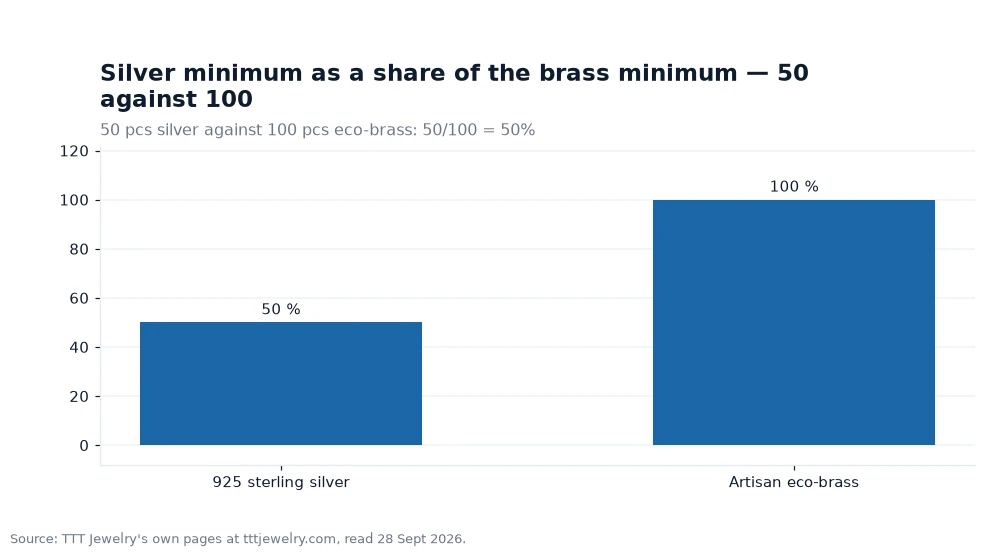
- 925 sterling silver starts at 50 pieces per design, half the 100-piece artisan eco-brass minimum.
- Approval to delivery adds 21–28 days, bringing the full CAD, sample and bulk route to 48–60 days.
- ISO 9001:2015 covers every production stage, which is what allows a signed-off sample to be repeated rather than remembered.
Where sampling sits in the six-step flow
The published sequence runs inquiry, consultation and development, CAD and prototype, sample and approval, bulk production, then final QC and delivery. Sampling is the fourth step and the first one that produces something a buyer can put on a finger. Everything before it is intent. Everything after it is repetition.
That position explains the calendar. A CAD model can be revised in an afternoon because it is data. A master sample cannot, because it is cast metal, a rubber mould, investment plaster, a plating bath and a setter's afternoon. Each of those has its own queue, and a fault found at the end of the chain sends the piece back to the front of it.
Brands that plan backwards from a launch date tend to learn the same lesson: the sample is not a preview of the product, it is the product's first physical draft. Treating it as a preview is how a 25–30 day window quietly becomes a 60-day one.
What the window contains, and what it cannot contain
Twenty-five to thirty days is 3.6 to 4.3 weeks. Inside that span the factory cuts or prints the master, builds the mould, casts trial pieces, polishes, plates, sets stones and inspects. The CAD step immediately before it takes 2 days, or 8% of a 25-day window and 6.7% of a 30-day window.
Those proportions are worth holding on to. Almost all of the pre-production clock is spent on operations that cannot be emailed. A buyer requesting a second CAD revision spends hours. A buyer requesting a second master spends weeks, and the difference in cost follows the same ratio.
What the window cannot absorb is a change of material. Moving from eco-brass to 925 sterling silver shifts the minimum from 100 pieces to 50 and changes the plating and anti-tarnish routine. Moving to stainless steel shifts the finish to PVD vacuum plating and the minimum to 100+ pieces. Either switch restarts the physical work, because the same geometry behaves differently in a different alloy.
Suppliers of custom jewelry manufacturing services are usually asked about speed first and material second. In practice the material question sets the floor for everything else, including price per unit, because it determines how much metal and how many finishing steps each piece consumes.
How minimums change the sample-to-scale maths
Silver begins at 50 pieces per design. Artisan eco-brass begins at 100 per design. The silver threshold is therefore half the brass threshold, which matters when the first bulk order is deliberately small.
Take one design and one mould. At 50 silver pieces, the fixed cost of sampling and tooling is spread over 50 units. At 100 brass pieces it is spread over 100, although each unit carries less metal value. Neither route wins on cost per piece without a quote; they differ in how much of a season's budget is committed to a single silhouette.
That commitment is the real constraint on scale. A ten-design collection at the silver minimum commits 500 pieces. The same collection in brass commits 1,000. A brand testing a new category can therefore halve its exposure simply by choosing the lower threshold, and it can release the remaining budget once the first three designs prove themselves at retail. It is also why a custom jewelry wholesale range tends to mix thresholds rather than standardise on a single metal.
The stainless line sits at 100+ pieces, which makes it a volume material rather than a test material. Its advantage is wear behaviour rather than sampling economics: 316L contains 2–3% molybdenum and is specified as shower-safe and swim-proof, so the piece survives the customer's routine long enough for reorder data to mean something.
Gate decisions that carry into bulk
Sampling is a series of signed decisions, not a single approval. Each gate fixes something and leaves something else open, and confusion about which is which is the most common cause of a bulk run that drifts from the approved piece.
| Gate | Fixed at the gate | Still open afterwards | Record |
|---|---|---|---|
| CAD sign-off | Proportions, wall thickness, stone seats | Surface finish, plating colour | Revision-numbered model |
| Master sample | Weight band, clasp mechanics, comfort | Small dimensional tolerances | Signed golden sample |
| Plating trial | Colour, thickness target, e-coating | Bath replenishment schedule | Colour standard under agreed light |
| Pre-production | Stone layout, hallmark position | Order quantity per size | Approved spec sheet |
| Final QC | Nothing; it verifies | Nothing without a rework loop | 100% inspection record |
The last row is deliberate. Inspection does not set a standard, it confirms one. A factory that discovers the standard during final QC is inspecting too late, however thorough the inspection is.
Worked example
Run the published numbers on a single design scheduled for a spring launch. CAD takes 48 hours, which is 2 days. Sampling takes 25–30 days and bulk takes 21–28 days. The short route is 2 + 25 + 21 = 48 days. The long route is 2 + 30 + 28 = 60 days. At seven days per week, that is 6.9 to 8.6 weeks, which is why the published range is stated as roughly 7–9 weeks.
Now compare the CAD share. 48 hours inside a 600-hour window (25 days) is 8%. Inside a 720-hour window (30 days) it is 6.7%. A brand that budgets review time in proportion to those shares will allocate about one day of internal review for every twelve days of factory work, and it will not be surprised when the calendar moves.
Finally, the minimums. A 50-piece silver order and a 100-piece brass order for the same silhouette differ by exactly 50 pieces, so the silver route carries 50% of the unit exposure. If the design sells through at 50 pieces, the reorder arrives with a mould already proven and a sample already signed.
Frequently asked questions
How long does sampling take before bulk production?
Physical sampling is published at 25–30 days, which is 3.6–4.3 weeks, and it follows a CAD stage of under 48 hours. Bulk production then adds 21–28 days.
Can a design go straight from CAD to bulk without a master sample?
It can be attempted, but the master sample is where weight, clasp feel, stone security and plating colour are verified. Skipping it moves those risks into a run of 50 to 100 pieces or more.
Why is the silver minimum lower than the brass minimum?
925 sterling silver is published at 50 pieces per design and artisan eco-brass at 100, so the silver threshold is half the brass one and suits smaller test runs of a new silhouette.
What to review before the bulk order releases
Five items should be in hand before a purchase order is released: the signed golden sample, the revision-numbered CAD file, the plating colour standard, the approved spec sheet and the inspection record format. Each takes minutes to check and each prevents a dispute that takes weeks to settle.
Brands adding a lower-priced tier often run the same design brief through a custom brass jewelry programme, keeping the silhouette and changing the metal. That works when the plating and anti-tarnish specification travel with the design rather than being renegotiated at the sample stage.
Scale is not a single decision. It is a series of small ones, each made while the evidence is still cheap to act on. Sampling exists to keep those decisions in that order.
Source note: figures come from the manufacturer's own website (tttjewelry.com), read 28 Sept 2026.[1]